Free calculator
Radio library storage calculator
How much space a station's audio actually takes, and how many tracks a given allowance holds. Music, jingles and recorded shows are all sized separately, because they behave differently.
Total library size
—
How the calculation works
A constant-bitrate file's size is simply its bitrate multiplied by its duration:
bitrate (kbps) ÷ 8 × seconds = kilobytes
A four-minute track at 256 kbps is about 7.7 MB. Variable-bitrate files vary either side of that, and the average across a real library lands close enough for planning.
What quality to store
Higher than you stream at, always. Encoding a 128 kbps stream from a 128 kbps file applies lossy compression twice to audio that has already had it applied once, and the artefacts compound audibly — a watery, smeared quality on cymbals and sibilants that nothing downstream repairs.
MP3 at 256 or 320 kbps is the practical sweet spot for a station library: comfortably above any stream you will run, and a third of the size of lossless. FLAC is worth it only if you are archiving as well as broadcasting.
What is not worth it is WAV. Uncompressed files are roughly five times the size of a 256 kbps MP3, for a difference nobody will hear through a lossy stream.
What actually grows
Music libraries grow slowly and predictably. The things that surprise people are:
- Recorded shows. One three-hour programme a week at 128 kbps is about 8 GB a year. Archive everything and it dwarfs the music.
- Duplicates. The same track imported from two sources under two spellings, taking up space twice and breaking separation rules into the bargain.
- Voice tracks. Individually tiny, and there are thousands of them over a few years.
- Seasonal libraries. A Christmas folder is dead weight for eleven months and nobody ever deletes it.
How big does a station library need to be?
Fewer tracks than most people assume. A focused format sounds better with 800 well-chosen songs than with 8,000 unfiltered ones, because rotation and separation rules work with the pool you give them — a library full of tracks you would rather not air is a library that will air them.
Around 1,000–2,000 tracks is comfortable for a single-format station. Above 5,000 you are usually running several formats, or you have stopped curating.
Frequently asked questions
How much storage does 1,000 songs need?
About 3.6 GB at 128 kbps, 5.5 GB at 192, 7.3 GB at 256 and 9.1 GB at 320, assuming an average length just under four minutes. Lossless is roughly 26 GB for the same catalogue, and uncompressed WAV about 40 GB.
Should I upload MP3 or WAV to a radio automation system?
MP3 at 256 kbps or higher. The stream is lossy regardless, so uncompressed files cost five times the storage for an inaudible difference — and slow every upload and import you do.
Does deleting a track free the space immediately?
Usually, but check whether the file is still referenced by a playlist, a clock or an archived show before assuming it has gone. Storage that will not go down is nearly always something still pointing at it.
How much storage does RadioHost Studio include?
10 GB on the station plan, which holds roughly 1,370 tracks at 256 kbps or 2,700 at 128 kbps at an average length just under four minutes, plus imaging.
See it for real
See what 10 GB of library looks like.
Uploads, loudness handled on import, artwork and metadata filled in — the media library this calculator sizes, walked through on a station that is already running.
- About 12 minutes
- No account, no credit card
- Real screens, not mockups
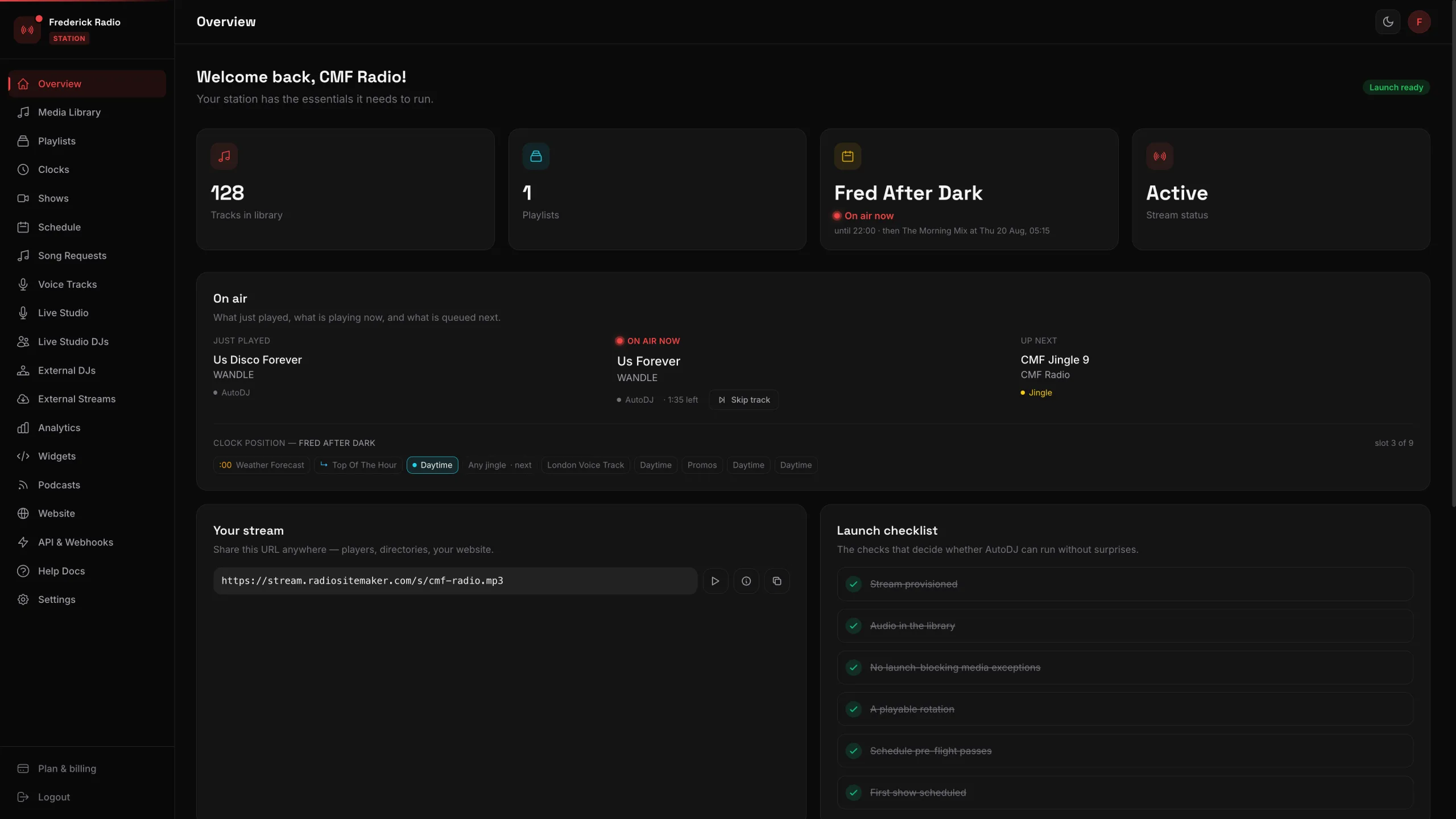 24 screens of a working station, walked through one click at a time