Learn
Radio broadcasting and automation, explained
Plain explanations of the technical decisions behind an online radio station: stream formats and bitrates, loudness, clockwheels, voice tracking, dead air, failover and listening-hour costs.
Getting started
How to start an internet radio station
The six decisions that actually matter when you start your own radio station — music rights, automation, streaming, and what it costs — in the order you have to make them.
Streaming
What bitrate should an internet radio station stream at?
128 or 192 kbps, MP3 or AAC, one stream or several — what bitrate actually changes for listeners, what it costs in bandwidth, and how to choose without guessing.
Streaming
AAC vs MP3 for radio streaming
AAC is the better codec and MP3 is usually the better choice for a radio station. Why compatibility beats efficiency here, and the cases where it does not.
Streaming
Icecast vs SHOUTcast: which should a radio station use?
The two streaming servers behind most online radio, what actually differs between them in 2026, and why the choice matters less than the protocol your encoder speaks.
Audio
Loudness, LUFS and why your station lurches
Why one track shouts and the next disappears, what LUFS measures that peak levels do not, and how automatic levelling makes a mixed library sound like one station.
Programming
Voice tracking: how pre-recorded radio sounds live
What voice tracking is, how presenters record an hour of links in fifteen minutes, the overlap settings that make it convincing, and where it stops working.
Programming
Clockwheels: how radio hours are actually built
The clockwheel is why a station sounds like itself at 3pm and 3am. What the slots do, how rotation and separation rules work, and what back-timing solves.
Operations
Dead air: what causes it and how stations prevent it
Every way an online radio station goes silent — source drops, empty schedules, missing files, expired feeds — and the fallback layers that stop each one.
Operations
Total listening hours: the number radio hosting is actually priced on
TLH is the unit almost every radio host bills in, and the one most easily misread. How it is calculated, what a realistic figure looks like, and how to control it.
Programming
AutoDJ vs automation vs live: what actually runs a radio station
AutoDJ, radio automation and live broadcasting solve three different problems, and the words get used interchangeably. What each one does, and what a real station uses.
Operations
What an online radio station actually costs to run
The real monthly cost of an internet radio station in 2026 — hosting, licensing, music, equipment and the costs people forget — with honest figures at three scales.
Software
Free radio automation software: what actually works
RadioDJ, LibreTime, AzuraCast, Rivendell and PlayIt Live compared honestly — what each one costs you in setup, maintenance and hosting once the licence is free.
See it for real
Stop reading about it — watch it run.
Everything this page describes as a concept is a screen in RadioHost Studio: the clockwheel editor, the week grid, the voice-track recorder, the play log. The guided tour walks through all of them on a station that is on air, with no account and nothing to install.
- About 12 minutes
- No account, no credit card
- Real screens, not mockups
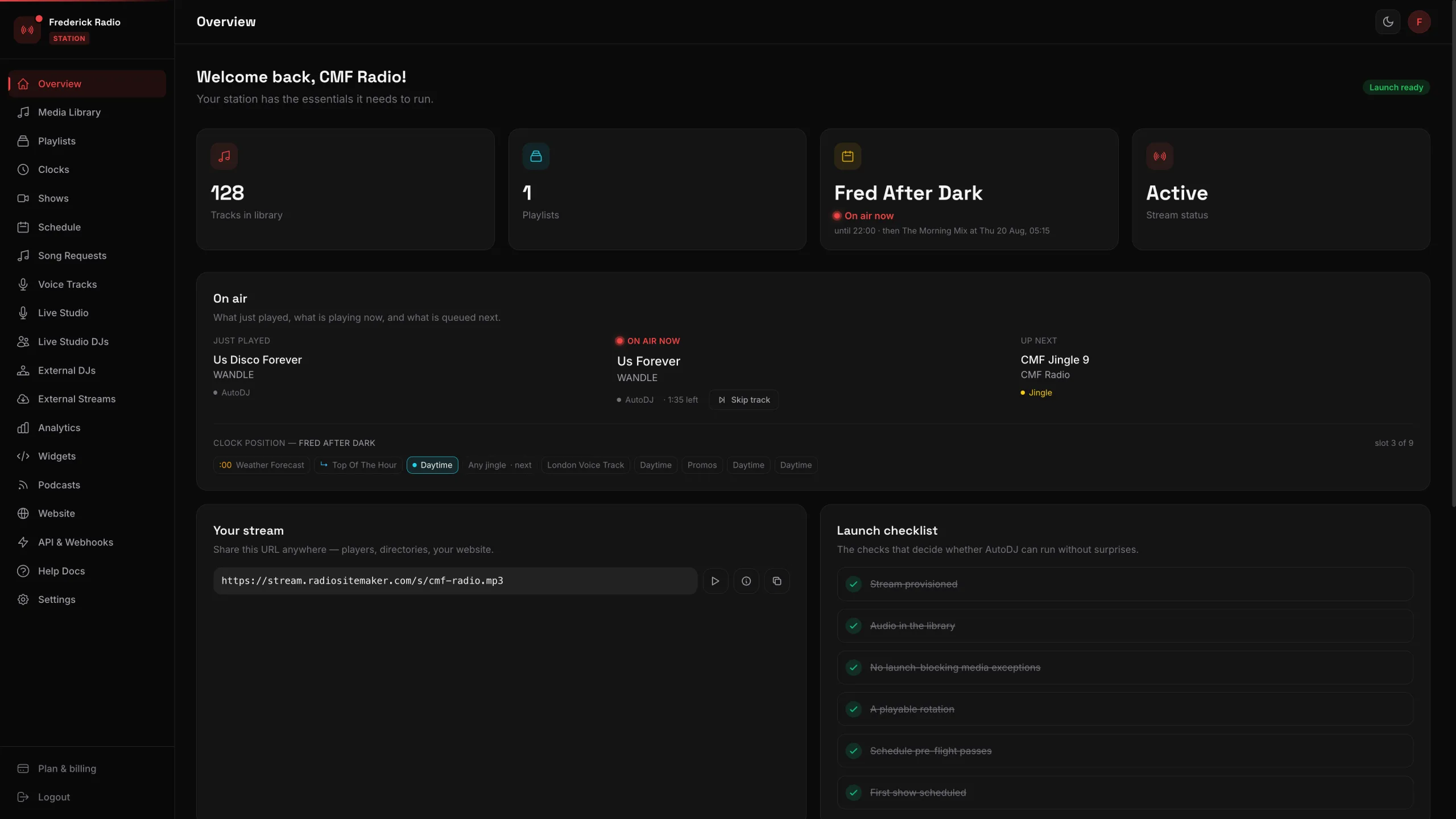 24 screens of a working station, walked through one click at a time