Reference
Radio terms glossary
Plain-English definitions of the radio, streaming and automation terms broadcasters actually use — from AGC and back-timing to voice tracking and TLH. 114 terms, written for people who have to use them rather than pass an exam in them.
A
- AAC
- A lossy audio codec that is more efficient than MP3 — roughly the same quality at about three quarters of the bitrate. Widely but not universally supported by radio players, which is why most stations still stream MP3.
- Ad-lib
- Unscripted speech. A presenter talking around a point rather than reading it. Most of what makes live radio sound live is ad-libbed over a scripted skeleton.
- ADTS
- The framing used to carry AAC over a live stream, allowing a player to join mid-flight. AAC inside an MP4 container cannot be streamed this way, which is the cause of most "AAC doesn't work" reports.
- AGC
- Automatic Gain Control. Processing that continuously raises quiet audio and lowers loud audio to hold a consistent level. Useful on unpredictable live sources; damaging on music, where it flattens intended dynamics.
- AoIP
- Audio over IP. Carrying studio-quality audio across a network instead of over cables, using protocols such as Dante or AES67. Standard in professional facilities, rarely relevant to a small online station.
- Attenuate
- To reduce a signal's level. The opposite of gain. Expressed in decibels, always as a negative number.
- AutoDJ
- A basic feature that plays a list of uploaded files when no live source is connected. It has no rotation rules, dayparts or clockwheels — it is a music player, not automation.
- Automation
- Software that runs a station unattended: scheduling shows, filling hours from clockwheels, enforcing rotation and separation rules, placing jingles and presenter links, and recovering when something fails.
- Aux
- An auxiliary bus on a mixer — a separate mix that can be sent somewhere other than the main output. Commonly used for monitoring or for a telephone caller's feed.
B
- Back announce
- Naming a track after it has played, rather than before. Standard practice on music radio because it tells arriving listeners what they just heard.
- Back-timing
- Choosing tracks short enough to end exactly when a fixed event is due, so a pinned bulletin or junction starts on time without anything being cut off. Typically engaged a few minutes ahead.
- Bed
- Instrumental music played underneath speech. A news bed, a weather bed, a competition bed. Distinct from a jingle in that it is designed to be talked over.
- Bitrate
- The number of bits per second a stream spends on audio, in kbps. Higher sounds better and costs proportionally more bandwidth. 128 kbps is the common default for online radio; 192 is comfortable for music-led stations.
- Break
- A gap in the music for speech, adverts, news or a competition. A station's structure is largely a decision about how many breaks an hour has and how long they are.
- Buffer
- Audio held in memory before playback, so a momentary interruption in delivery does not become an interruption in sound. Larger buffers survive network jitter; they also increase the delay between broadcast and hearing.
- Bumper
- A short piece of production used to move between elements — out of a song and into an advert break, or out of news and back into music.
C
- Cans
- Headphones. Studio slang, still in daily use.
- Cart
- A single self-contained piece of audio ready to fire: a jingle, an ident, a trail, a sound effect. Named after the tape cartridges that held them from the 1960s to the 1990s.
- Clean feed
- A mix that excludes the contributor it is being sent to, so a caller or remote guest hears the studio but not themselves. Without it, they hear their own voice delayed, which makes speech almost impossible.
- Clipping
- What happens when a signal exceeds the maximum a digital system can represent: the peaks are flattened. It sounds harsh and it is permanent — nothing downstream can restore what was removed.
- Clockwheel
- A diagram of one hour's structure — music, sweeper, talk break, news at the top — that automation fills from the library each time it is used. The reason a station sounds like itself at any hour.
- Codec
- The scheme used to compress and decompress audio. MP3, AAC, Opus and Ogg Vorbis are codecs. Choosing one is a trade between efficiency and how many devices can play it.
- Compression (audio)
- Reducing the difference between the loudest and quietest parts of a signal, making the result feel more consistent and present. Not to be confused with data compression, which is what a codec does.
- Concurrent listeners
- How many people are connected at the same moment. This is what a "500 listener" plan limits — not how many people hear the station in a month, which is usually far higher.
- Cue
- To prepare audio for playback, or to listen to it privately before it airs. The cue bus is what a presenter hears in headphones without sending it to air.
- Cue point
- A stored marker on a piece of audio — where it truly starts, where the vocal begins, where it can be faded. Accurate cue points are what make automated segues sound deliberate.
D
- Dayparting
- Programming different content at different times of day, because the audience and its attention change. Breakfast, daytime, drive, evening and overnight are the standard divisions.
- dBFS
- Decibels relative to Full Scale — how close a digital signal is to the maximum it can represent. 0 dBFS is the ceiling; everything else is negative. Measures peaks, not loudness.
- De-esser
- Processing that reduces harsh "s" sounds in a voice without dulling the rest of it. Frequently the difference between a usable and an unpleasant microphone chain.
- Dead air
- Unintended silence going out to listeners. In online radio it is more damaging than on FM because players disconnect, and disconnected listeners do not return automatically.
- Deck
- One playback channel in a DJ setup. Two decks and a crossfader is the classic arrangement; four is common in software.
- Drive time
- The afternoon and early evening daypart, historically radio's second peak after breakfast, built around people travelling home.
- Duck
- To automatically reduce one source's level while another is present — music dropping under a presenter's voice, then returning. Also what automation does when a live source connects.
- Dynamic microphone
- A microphone that converts sound with a moving coil. Less sensitive than a condenser, which makes it forgiving of untreated rooms and the standard choice for broadcast speech.
- Dynamic range
- The distance between the quietest and loudest parts of a piece of audio. Heavy compression reduces it; the loudness war was a twenty-five-year competition to reduce it further.
E
- Encoder
- Software or hardware that compresses audio and sends it to a streaming server. BUTT, Mixxx, VirtualDJ and Audio Hijack are all encoders as far as a station is concerned.
F
- Fader
- A sliding control that sets a channel's level. Riding the faders means adjusting them continuously through a live show.
- Failover
- Automatic switching to a backup when a source fails. In radio it is layered: live source, then automation, then a fallback playlist, then a fallback file.
- Fallback
- What plays when the intended source has nothing to give — a rotation the station drops to when the schedule has a hole, a playlist is empty or files are unreachable.
- FLAC
- A lossless audio format: compressed to a smaller file with no quality loss. Excellent for a library, unnecessary for a stream, since every stream is re-encoded lossily anyway.
- Format
- A station's overall identity and musical policy — what it plays, who for, and how it presents. Also used, confusingly, for file format.
G
- Gain
- The amount a signal is amplified, in decibels. Set at the input, before everything else in the chain; getting it right at source prevents most problems later.
- Gain staging
- Setting levels sensibly at every point in a chain so nothing is starved or overdriven. Most audio problems that appear to be equipment problems are gain staging problems.
H
- Harbor
- The input point on a playout system where a live source connects. A presenter's encoder authenticates to the harbor and takes over the station from automation.
- HE-AAC
- High-Efficiency AAC. A variant that stays listenable at very low bitrates, where MP3 falls apart. The right choice for a mobile-data fallback stream, and only that.
- Headroom
- The distance between the current level and the point at which clipping starts. Audio with no headroom cannot be turned up without damage, regardless of how quiet it feels.
I
- Icecast
- Open-source streaming server software, maintained by Xiph.Org. Serves multiple streams from one host using mount points, supports MP3, AAC, Ogg and Opus, and is what most independent radio hosting is built on.
- Ident
- A short piece of production stating the station name. The single most important thing a station broadcasts, because a listener who cannot name you cannot look for you.
- Imaging
- The produced elements that give a station its sonic identity — idents, sweepers, beds, stagers. Collectively, what makes two stations playing the same songs sound different.
- Integrated loudness
- A loudness measurement taken across a whole piece of audio rather than at any single instant, expressed in LUFS. The number that levelling systems compare against a target.
J
- Jingle
- A short sung or produced piece carrying the station name or a show identity. The oldest and still most effective piece of radio branding.
- Junction
- A fixed point in the hour where something must happen — news, a network handover, a traffic bulletin. Junctions are what back-timing exists to hit.
K
- Kick
- An operator action that forcibly disconnects a live source, returning the station to automation. Needed when a presenter's software crashes and leaves the connection open but silent.
L
- Latency
- The delay between something happening and a listener hearing it. Buffering, encoding and delivery all add to it. Rarely important for music radio; critical for anything interactive.
- Limiter
- Processing that prevents audio from exceeding a set ceiling. As a safety net it catches mistakes and badly mastered files; as a sound it is a decision, and usually the wrong one.
- Liner
- A short spoken line, often over a music bed, restating a station's positioning. "The best music in the city." Written once, used constantly.
- Live assist
- A middle ground between automation and fully live: automation runs the hour while a presenter sits at it, firing links and adjusting as they go. Standard in most professional studios.
- Log
- The record of what actually aired, with times. Distinct from the schedule, which is what was meant to air. Royalty reporting is built on the log.
- Loudness
- How loud audio feels over time, as opposed to how tall its peaks are. Measured in LUFS. The reason a quiet-sounding file can peak just as high as a loud one.
- LUFS
- Loudness Units relative to Full Scale — the broadcast standard for perceived loudness, weighted the way hearing is. Lower is quieter; −14 LUFS is a common streaming target.
M
- Mic processing
- The chain applied to a voice on its way to air — gain, de-essing, compression, EQ, limiting. Modest settings sound professional; aggressive ones sound like a bad advert.
- Mixdown
- Combining several audio sources into one. Also the finished result of that process.
- Mono
- A single audio channel. At very low bitrates mono genuinely sounds better than stereo, because all the bits go to one channel instead of two — a real trade for a speech station.
- Mount point
- The path a stream lives at on an Icecast server, such as `/live`. One server can host many mounts, which is how a provider serves hundreds of stations from one hostname.
- MP3
- The most widely supported lossy audio codec in existence. Less efficient than AAC, and still the right choice for public radio streaming because it plays on every device a listener might own.
N
- Normalisation
- Adjusting a file's level to a target. Peak normalisation matches the loudest instant and does nothing for how loud files feel; loudness normalisation matches perceived level and is what stations want.
- Now playing
- The metadata describing what is currently on air, sent with the stream and displayed by players, websites and aggregators. Absent metadata is why some stations show the same track for hours.
O
- OB
- Outside Broadcast. A programme originating from somewhere other than the studio — an event, a venue, a street. Once a major engineering exercise; now often a laptop and a good connection.
- Ogg Vorbis
- An open, patent-free lossy codec supported by Icecast. Technically good, poorly supported by hardware radio players, which limits it to closed systems.
- On demand
- Content available whenever a listener chooses, as opposed to live or scheduled. A show published after broadcast is on demand; a podcast is on demand by definition.
- Opus
- A modern, highly efficient open codec, excellent at low bitrates. The right choice when you control both ends; the wrong one for a stream a stranger's car stereo will try to open.
- Overrun
- A programme continuing past its scheduled end, pushing everything after it late. On automated stations, the cause is usually an item longer than the slot that held it.
P
- Peak
- The loudest single instant in a piece of audio, measured in dBFS. Tells you about clipping risk and almost nothing about how loud something feels.
- Phantom power
- 48 volts sent down a microphone cable to power a condenser microphone. Harmless to most dynamic microphones, but switch it off when it is not needed.
- Playout
- The system that actually sends audio to air — the thing holding the audio files, obeying the schedule and feeding the encoder. The engine underneath automation.
- PPM
- Peak Programme Meter. A meter with a defined, relatively slow response designed to show broadcast levels usefully, rather than every instantaneous peak.
- Pre-fade
- Listening to a channel before its fader is raised, so it can be checked and cued without going to air. Also called PFL.
- Pre-record
- Recording a programme in advance to be played at its scheduled time. Different from voice tracking, where only the links are recorded and the music is pulled live from the library.
- PRO
- Performance Rights Organisation. Collects royalties on behalf of songwriters and publishers. ASCAP, BMI, SESAC and GMR in the US; PRS for Music in the UK.
- Production
- Making the audio: recording, editing, mixing, adding beds and effects. Also the department that does it.
- Programme director
- The person responsible for what the station sounds like — format, music policy, presenters, structure. Often the same person as everyone else at a small station.
R
- Rate card
- The published prices for advertising on a station. Rarely what anyone actually pays, but necessary to have.
- Reach
- How many different people heard the station in a period, as opposed to how many were listening at any moment. Reach and concurrency measure different things and are frequently confused.
- Relay
- Rebroadcasting another station's stream. Common for news at the top of the hour, and a licensing matter as much as a technical one.
- ReplayGain
- An early standard for storing a loudness correction alongside a file rather than changing the audio. Superseded by LUFS-based measurement in broadcast, same idea.
- Rotation
- The rules deciding which track comes next from a pool — typically least recently played first, so the library is worked evenly instead of favouring whatever sorts to the top.
- Royalty report
- The submission to a collecting society listing what was played, how often and to how many listeners. Generated from the play log, which is why accurate logging matters.
S
- Sample rate
- How many times per second audio is measured, in Hz. 44100 Hz is what music files use and what streams should use; converting to 48000 for a stream adds a step and gains nothing.
- Segue
- The transition from one piece of audio into the next. A good segue is inaudible as a decision; a bad one is the most noticeable thing in the hour.
- Separation
- Rules preventing the same track or artist recurring too soon — typically a couple of hours for a track, under an hour for an artist. Invisible when it works, glaring when it does not.
- SFX
- Sound effects. Used sparingly in modern radio production, and instantly dating when they are not.
- SoundExchange
- The US organisation that collects digital performance royalties for sound recordings, billed per performance — per song, per listener. Separate from and additional to composition licensing.
- Source
- Anything feeding audio into the station: automation, a presenter's encoder, a browser studio, a relay. A streaming server accepts one source and fans it out to listeners.
- Spin
- One play of one track. The unit of both programming analysis and royalty reporting.
- Stager
- A short produced element that carries the station identity into or out of a specific feature — the sting before the travel news, or after the competition.
- Stereo
- Two audio channels, left and right. Standard for music. Costs twice the bits of mono at the same per-channel quality, which matters only at very low bitrates.
- Sting
- A very short piece of music or production used as punctuation. Two seconds, often less.
- Stream URL
- The address a player connects to in order to hear the station. Publishing it is how aggregators, apps and third-party players reach you.
- Sweeper
- A produced element that moves the listener from one thing to the next while restating the station name. The workhorse of radio imaging.
T
- Talk break
- A slot in a clockwheel reserved for presenter speech, filled by a live presenter or by the next queued voice track. If nothing is queued, automation steps over it.
- Talkback
- A private communication path between studio, control room and contributors that never reaches air.
- Terrestrial radio
- Broadcasting over the air on AM, FM or DAB, as opposed to over the internet. The two are not competitors so much as different distribution for the same product.
- TLH
- Total Listening Hours. The sum across all listeners of how long each listened. Ten listeners for six hours is sixty TLH. The unit most radio hosting is priced in.
- TLS
- The encryption behind HTTPS. Relevant to radio because a browser on a secure page will refuse to play an insecure stream, which breaks website players.
- Trail
- A promotional announcement for a forthcoming programme. The most reliable way to move an audience from one show to another.
- TSL
- Time Spent Listening. How long the average listener stays. A more meaningful growth metric than headcount, because long sessions are what a station is actually for.
V
- Voice track
- A single pre-recorded presenter link, placed by automation between two songs. Typically ten to thirty seconds.
- Voice tracking
- Recording a show's links separately from the music and having automation place them. Lets a presenter produce a three-hour show in twenty minutes, and lets a small station sound hosted around the clock.
- VU
- Volume Unit. A meter with a deliberately slow response that reads something closer to perceived loudness than a peak meter does. Still found on hardware, still useful.
W
- Wet and dry
- Processed and unprocessed. A wet signal has effects applied; a dry one does not.
- Widget
- An embeddable player, schedule or track history for a station website. What connects a station's stream to the page a listener actually lands on.
- Windshield
- The foam or fur cover on a microphone that reduces wind noise and plosives. Cheap, and the difference between a usable and an unusable outdoor recording.
X
- XLR
- The three-pin balanced connector used for professional microphones. Balanced cabling rejects interference over long runs, which is why studios use it and USB microphones do not need it.
Z
- Zone
- A separately-addressable audio output in a multi-site installation — a floor, a room, a store. Relevant to in-store and internal-communications radio rather than broadcast.
See it for real
Every one of these words is a screen somewhere.
Clockwheels, separation rules, back-timing, voice tracks, failover — the guided tour shows where each of them actually lives, on a station that is on air. No account needed.
- About 12 minutes
- No account, no credit card
- Real screens, not mockups
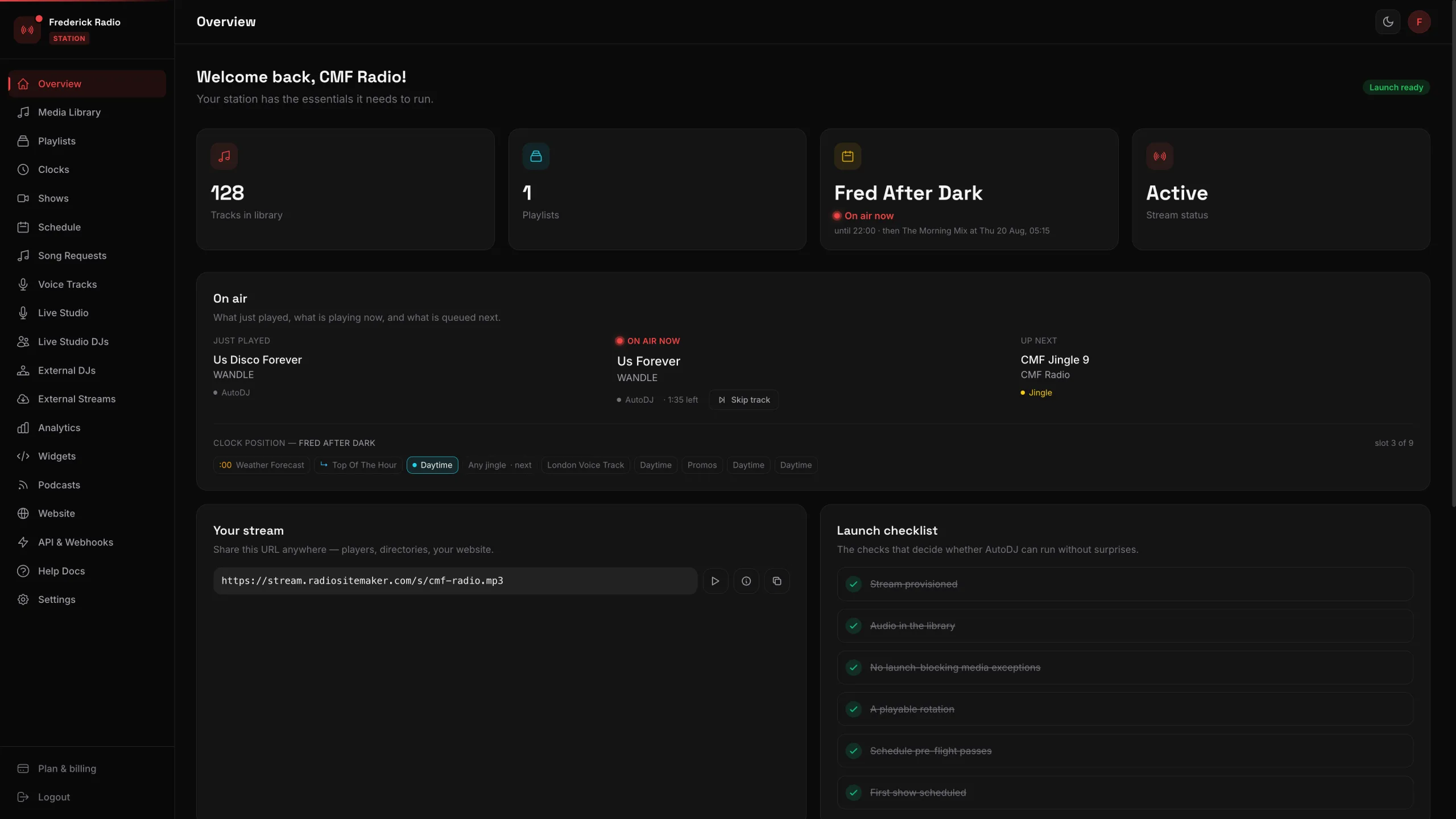 24 screens of a working station, walked through one click at a time